 Shelf & Square
Measure a kitchen drawer for an expandable organizer
Find the width, depth and height that matter before ordering a drawer insert.
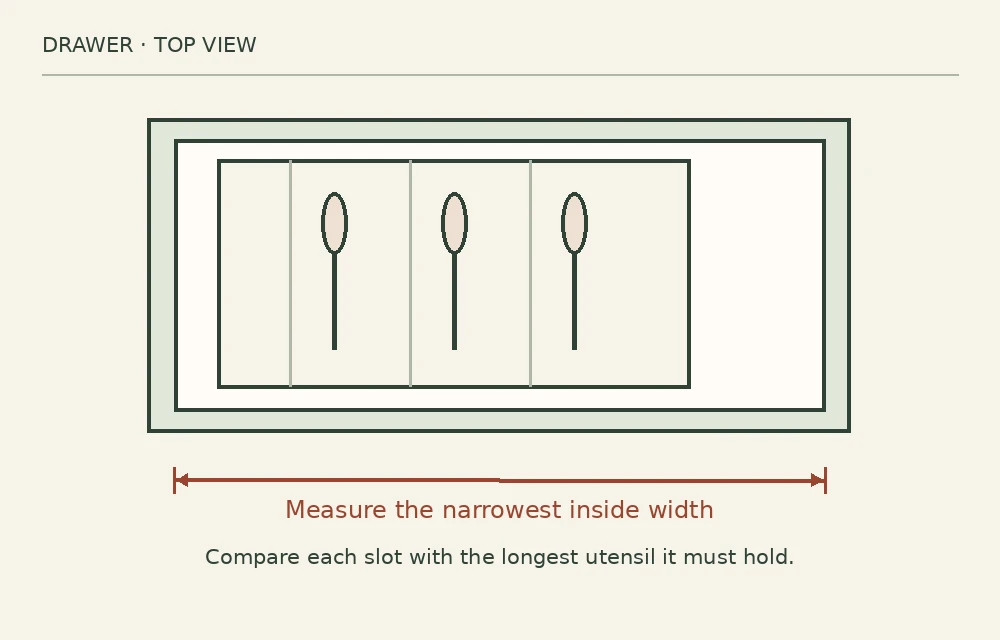
Measure inside the drawer box
Record the usable width at the front and back. A tapered drawer or side hardware can make the narrowest point the limiting width. Measure to the back edge, then close the drawer slowly with a folded paper marker to spot any overhead obstruction.
Check your longest utensils
Lay out the utensils you want to keep and mark the length of the longest one. Compare each individual compartment with the utensil it will hold. The outside dimensions alone cannot tell you whether a spatula or pair of tongs will fit. Try opening the drawer with the utensils in a shallow cardboard mockup.
Compare the tray with the usable opening
Check the manufacturer's external dimensions before ordering. Compare the narrowest drawer width with the tray's minimum width, confirm which way it expands, and check height where the drawer passes under the frame. Leave enough clearance to lift the insert out for cleaning. A short fixed tray or individual dividers can suit a shallow drawer or a small utensil collection.
Check which measurement can change
An adjustable organizer may expand along only one axis. Look at the product diagram to see which edge moves, and check that an expanded wing does not interfere with a drawer side or handle fastener. Full-depth organizers are useful only where the back section is easy to reach. If you rarely open the drawer all the way, keep daily utensils in the front half or use a shorter tray.